
Intro to CMS Physics Objects
Last updated on 2026-07-16 | Edit this page
Estimated time: 5 minutes
Overview
Questions
- What do we call physics objects in CMS?
- How are physics objects reconstructed?
- How are physics objects represented in NanoAOD?
Objectives
- Learn about the different physics objects in CMS and get briefed on their reconstruction
- Learn more about the collection structure of NanoAOD
Overview
The CMS experment is a giant detector that acts like a camera that “photographs” particle collisions, allowing us to interpret their nature.
Certainly, we cannot directly observe all the particles created in the collisions because some of them decay very quickly or simply do not interact with our detector. However, we can infer their presence. If they decay to more stable particles and interact with the material of the detector, they leave signals that CMS can record. These signals are used to determine the presence of specific types of particles moving through the detector – we call these, physics objects.
The CMS detector has many many sensors of different kinds that can detect signals from particles passing through. Take a look at the CMS experiment in the image below. This is a good recent video that you can watch later to get a quick feeling of how CMS looks now in Run 3.
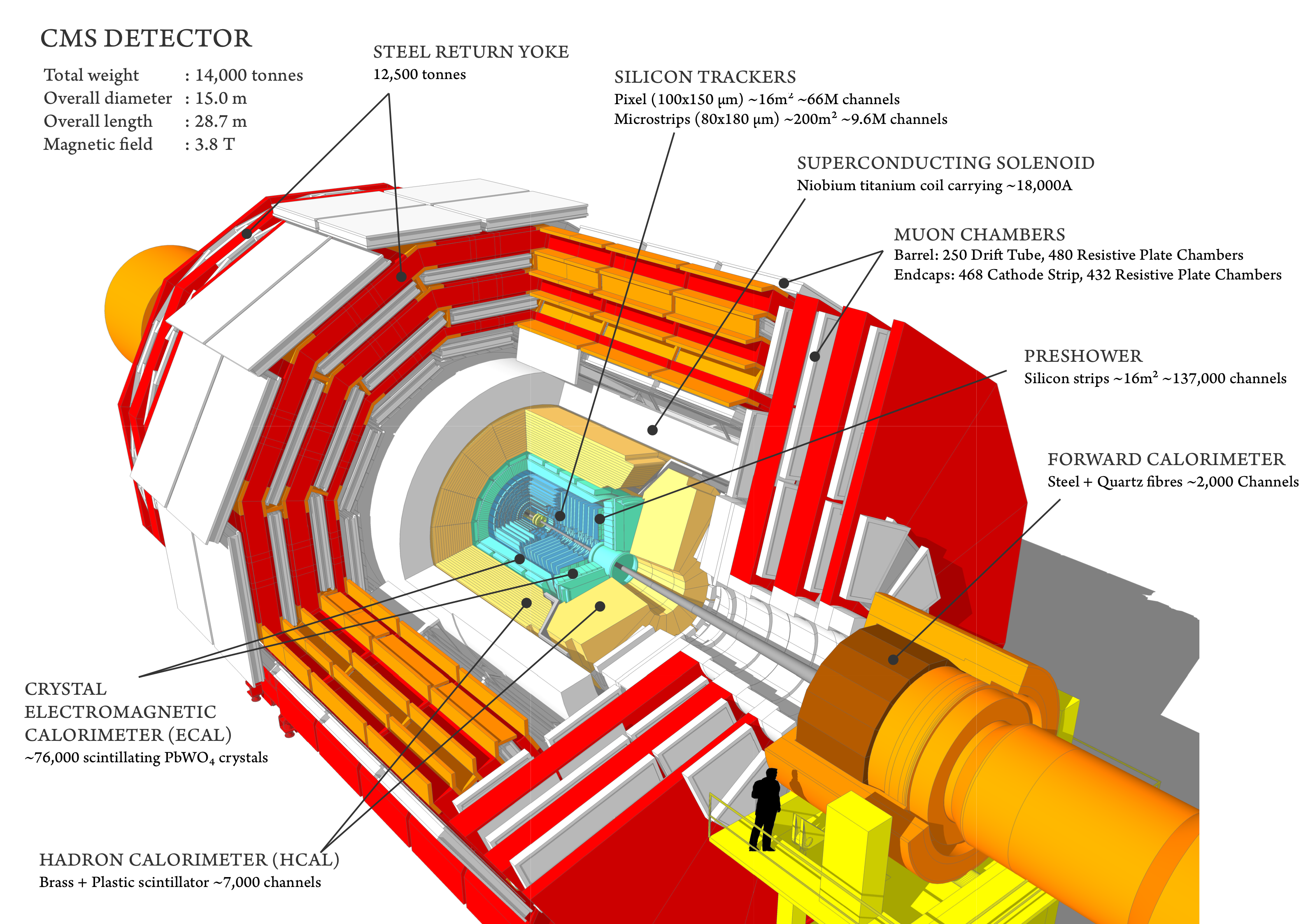
Physics objects can be:
- electrons
- muons
- photons
- “jets” (cones of energy from particles made of quarks)
- tau leptons
- missing transverse momentum
On the CERN Open Portal (CODP) site you can find a more detailed description of these physics objects and a list of them corresponding to 2010, 2011/2012, and 2015/2016 releases of open data.
In this workshop we will focus on working with open data from the latest 2016 release from Run 2. This release included the NanoAOD file format that contains the most commonly used physics object information in a standard ROOT tree.
Physics Objects reconstruction
Physics objects are mainly reconstructed using methods like clustering adjacent signals and linking information between different CMS detector components. For instance, electromagnetic objects (electrons or photons) are reconstructed by linking tracks from the inner tracking detectors with energy clusters in the electromagnetic calorimeter.
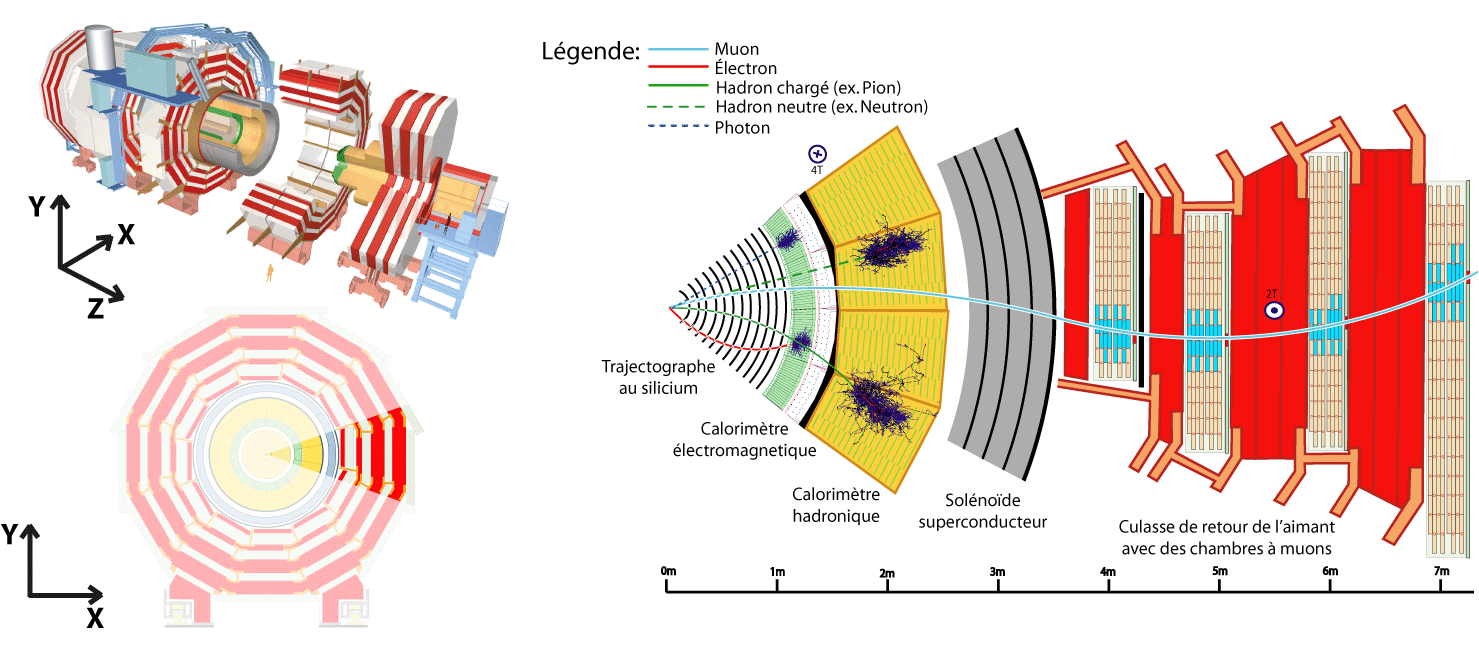
These actions are essential parts of the so-called Particle Flow (PF) algorithm.
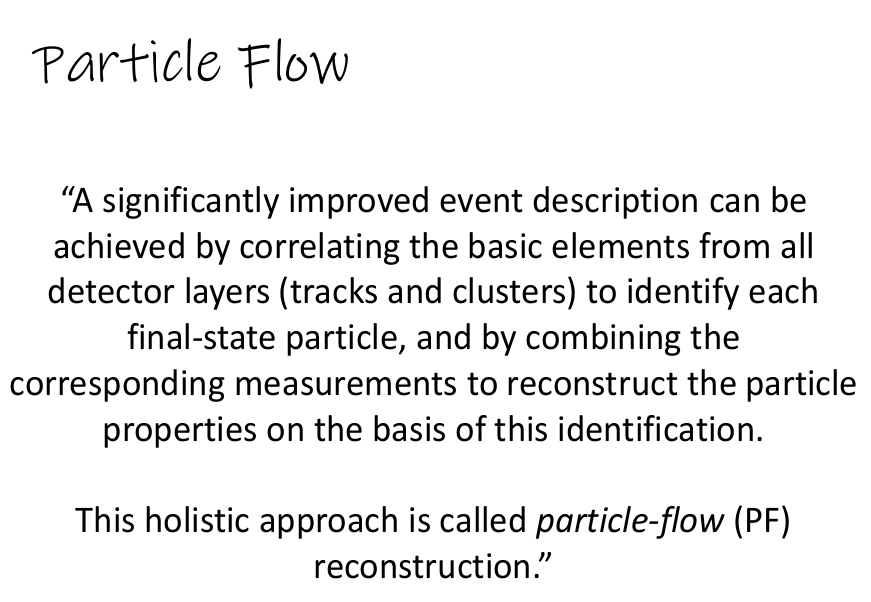
The particle-flow (PF) algorithm aims at reconstructing and identifying all stable particles in the event, i.e., electrons, muons, photons, charged hadrons and neutral hadrons, with a thorough combination of all CMS sub-detectors in order to best determine their direction, energy and particle type. This list of individual particles is then used to build jets, to determine the missing transverse energy (which gives an estimate of the direction and energy of the neutrinos and other invisible particles), to reconstruct and identify tau leptons from their decay products, and more.
The PF algorithm is written in C++ and is part of the CMSSW software that is required to analyze any open data in the earlier AOD or MiniAOD formats. For more information about the PF algorithm you can visit a lesson from an earlier workshop: Advanced Tools lesson. The CMS open data from 2016 contains some data samples in the NanoAOD format that have been supplemented with particle flow information: nanoad-pf samples.
- Physics objects are the final abstraction in the detector that can be associated to physical entities like particles.
- NanoAOD stores physics object properties as branches of a ROOT tree, linked by common name prefixes.