
Jet flavor tagging
Last updated on 2026-07-16 | Edit this page
Overview
Questions
- How are b hadrons identified in CMS?
- How are the parent particles of large-radius jets identified in CMS?
Objectives
- Understand the basics of heavy flavor tagging
- Learn to access tagging information in NanoAOD files
Jet reconstruction and identification is an important part of the
analyses at the LHC. Jets can originate from many different types of
particles. The figure below gives an example of how different “parent
particles” can influence the internal structure of a jet. Observables
related to the mass and internal
structure of a jet can help us design algorithms to distinguish
between sources. 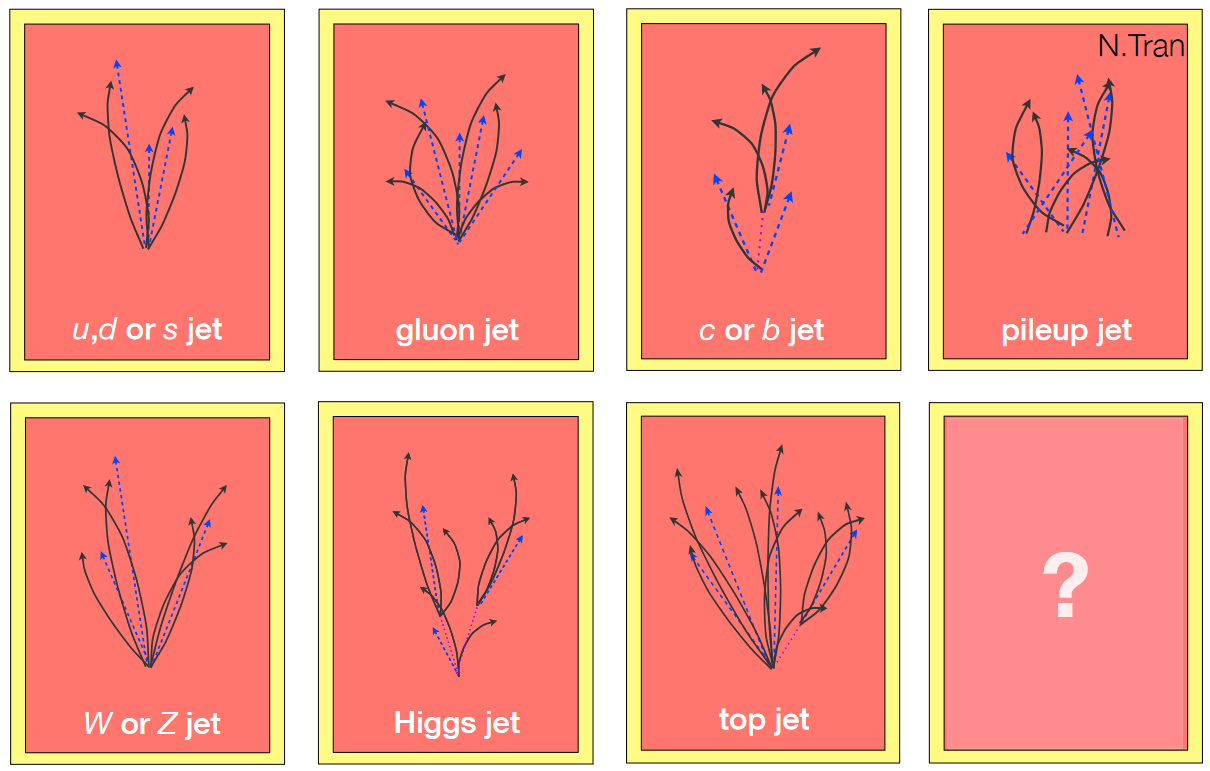
Several “b tagging” algorithms exist to identify jets from b quarks, which have unique properties that distinguish them from light quark or gluon jets.
B Tagging Algorithms
Tagging algorithms first connect jets with particle tracks that are either connected to one of the jet’s particle flow candidates, or lie within a nearby cone. Both tracks and “secondary vertices” (points where multiple tracks emerge within a jet) can be used in track-based, vertex-based, or “combined” tagging algorithms. The specific details depend upon the algorithm, but they all rely on special properties of b hadrons such as:
- long lifetime compared to other particles produced in a collision, which allows b hadrons to travel away from the collision before decaying,
- large mass,
- high number of tracks compared to other types of quark jets,
- higher probability of producing a low-momentum electron or muon.
In recent CMS Open Data, the most important b-tagging algorithms are:
- Combined Secondary Vertex (CSV): many properties of jets, tracks, and secondary vertices are combined into a “boosted decision tree”, which is a simple form of machine learning. This tagger became the default CMS algorithm in Run 1 and early Run 2.
- DeepCSV: the CSV algorithm was reimagined as a deep neural network.
- DeepJet: this deep neural network tagger uses a more complex architecture than DeepCSV, and is the most powerful b tagging algorithm for Run 2.
These algorithms produce a single, real number called a b tagging “discriminator” for each jet. The more positive the discriminator value, the more likely it is that this jet contained b hadrons. The DeepCSV and DeepJet algorithms can also identify charm-flavor jets, and DeepJet can even distinguish between light-quark and gluon jets.
| Object property | Type | Description |
|---|---|---|
| Jet_btagCSVV2 | Float_t | pfCombinedInclusiveSecondaryVertexV2 b-tag discriminator (aka CSVV2) |
| Jet_btagDeepB | Float_t | DeepCSV b+bb tag discriminator |
| Jet_btagDeepCvB | Float_t | DeepCSV c vs b+bb discriminator |
| Jet_btagDeepCvL | Float_t | DeepCSV c vs udsg discriminator |
| Jet_btagDeepFlavB | Float_t | DeepJet b+bb+lepb tag discriminator |
| Jet_btagDeepFlavCvB | Float_t | DeepJet c vs b+bb+lepb discriminator |
| Jet_btagDeepFlavCvL | Float_t | DeepJet c vs uds+g discriminator |
| Jet_btagDeepFlavQG | Float_t | DeepJet g vs uds discriminator |
Working points
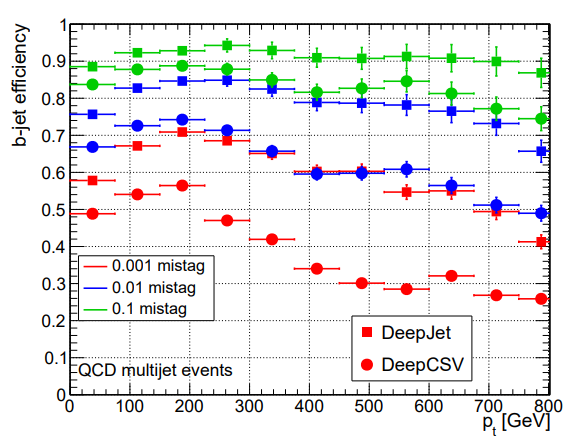
A jet is considered “b tagged” if the discriminator value exceeds some threshold. Different thresholds will have different efficiencies for identifying true b quark jets and for mis-tagging light quark jets. As we saw for muons and other objects, a “loose” working point will allow the highest mis-tagging rate, while a “tight” working point will sacrifice some correct-tag efficiency in order to reduce mis-tagging. The DeepCSV and DeepJet algorithms are supported by CMS for 2016 Open Data.
The supported working points for DeepCSV and DeepJet for the 2016 Open Data are:
- Loose (10% misidentification rate):
Jet_btagDeepB> 0.1918 ,Jet_btagDeepFlav> 0.0480 - Medium (1% misidentification rate):
Jet_btagDeepB> 0.5847,Jet_btagDeepFlav> 0.2489 - Tight (0.1% misidentification rate):
Jet_btagDeepB> 0.8767,Jet_btagDeepFlav> 0.6377
The figure below shows the relationship between b jet efficiency and working point in DeepCSV and DeepJet:
FatJet tagging algorithms
In CMS NanoAOD, the “fat” jets have a larger cone size than standard jets. These larger jets are ideal for identifying top quarks or W, Z, or Higgs bosons that have been produced with high momentum and have decayed to several quarks. All of these decay products can be caught within one large-radius jet cone. Several identification algorithms are used in CMS to tell the different sources apart.
Groomed mass and substructure
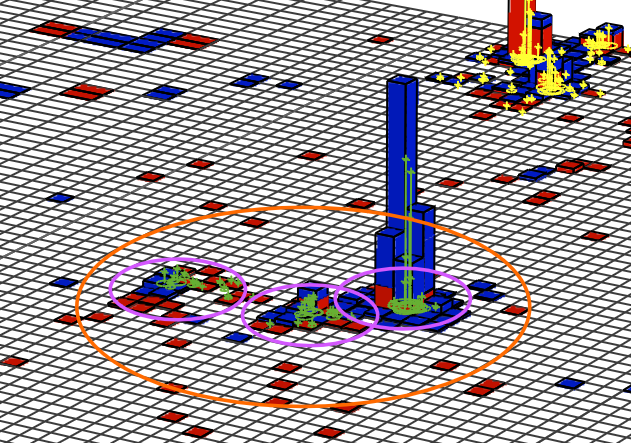
The mass of a jet is evaluated by summing the energy-momentum four-vectors of all the particle flow candidates that make up the jet and computing the mass of the resulting object. This mass calculation is distorted by gluons that radiate energy away from the initial particles that formed the jet. For example, the masses of light quark jets are measured to be much larger than the actual masses of these quarks – typically 10–50 GeV. Mass Grooming procedures can help reduce the impact of this radiation and bring the jet mass closer to the true values of the parent particles. Grooming algorithms typically cluster the jet’s consitituents into “subjets”, like those represented by the small circles in the figure below. The relationships between different subjets can then be tested to decide which to keep.
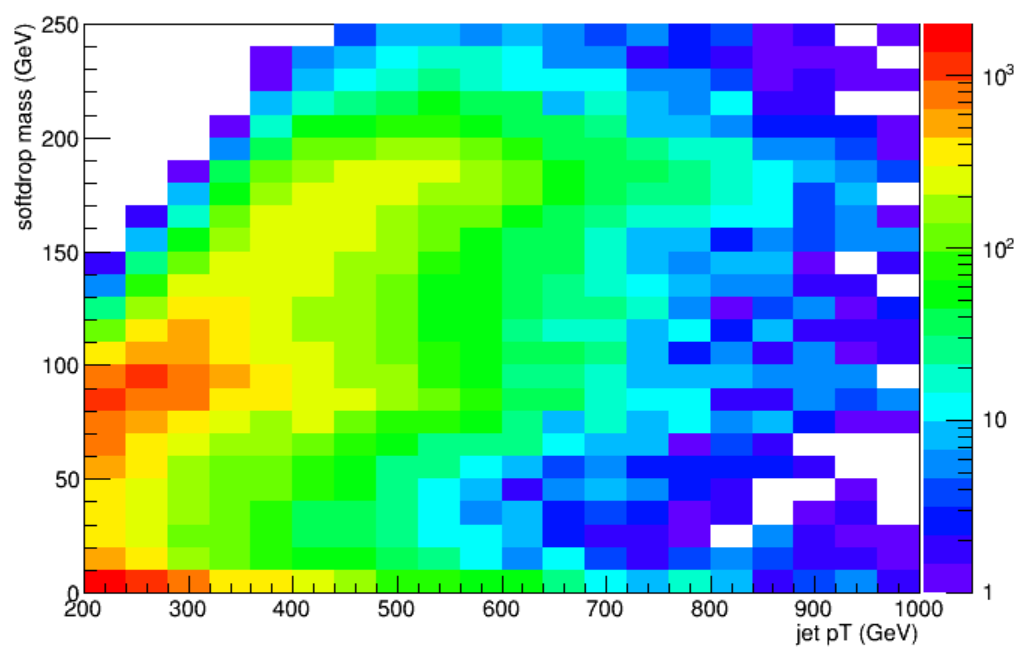
The “softdrop” mass is included in NanoAOD for large-radius jets. In the “softdrop” procedure, jets are recursively de-clustered, and at each step subjets that are too low in momentum or large angles separating them from other subjets are discarded. The following image shows the relationship between FatJet momentum, mass, and jet radius. As the momentum increases, jets of larger mass become contained within the FatJet. While W bosons with a mass of 80 GeV can be observed from 200 GeV, top quarks with a mass of 170 GeV require a higher momentum threshold.
The internal structure of a jet can be probed using many observables: N-subjettiness, energy correlation functions, and others. In CMS, N-subjettiness is the default jet substructure variable for identifying boosted particle decays.
The “tau” variables of N-subjettiness, defined below, are jet shape variables whose value approaches 0 for jets having N or fewer subjets. Top quarks typically decay to 3 quarks, so we would expect small tau values for N = 3, 4, 5, 6, etc, but larger values for N = 1 or 2.
\(\tau_{N} = \frac{\sum^{n_{\mathrm{constituents}}}_{i=1} p_{\mathrm{T},i} \min{\Delta R_{1,i}, \Delta R_{2,i}, \ldots, \Delta R_{N,i}}}{\sum^{n_{\mathrm{constituents}}}_{i=1} p_{T,i}R}\)
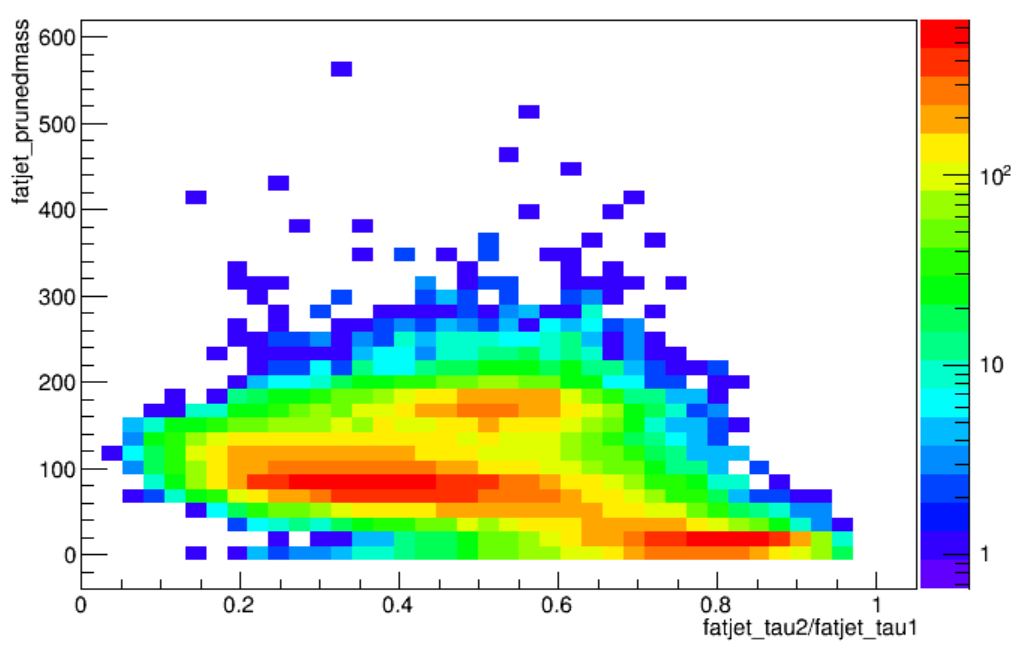
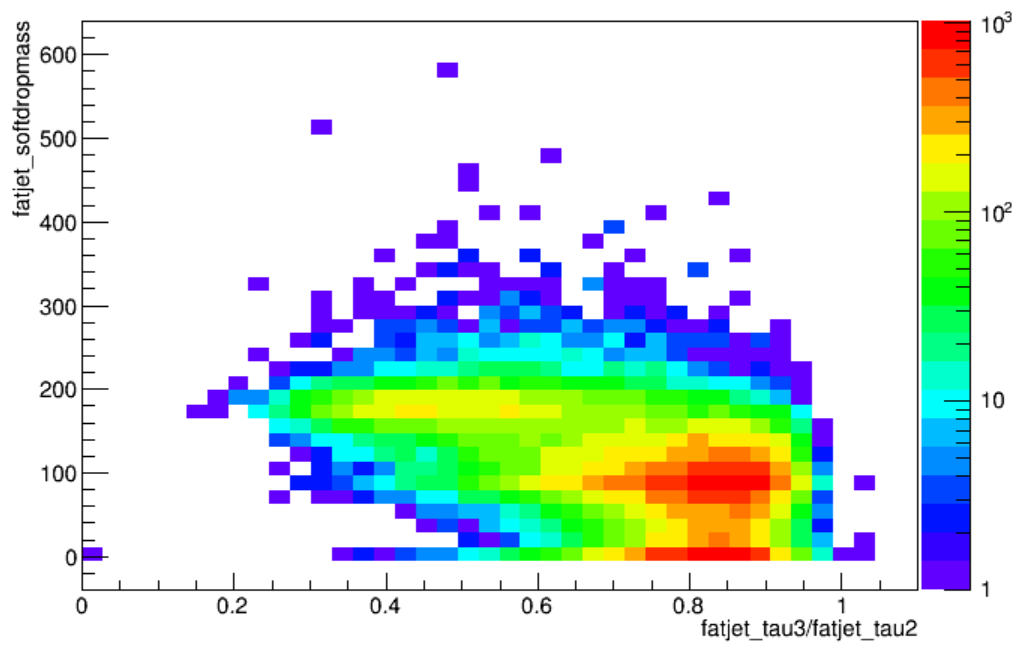
Ratios of tau values provide the best discrimination for jets with a specific number of subjets. For two-quark jets like W, Z, or H boson decays, we study the ratio tau_2 / tau_1. For three-quark jets we study tau_3 / tau_2.
The figures below show the relevant tau ratios for W boson (left) and top quark (right) jets. The structure in the tau_2/tau_1 plot is very unique: W bosons pool at lower values of tau_2/tau_1, while top quarks (with more than 2 subjets) and light quarks (with only 1 subjet) pool at medium and higher values. In the tau_3/tau_2 plot, top quark jets have low values while both W boson and light quark jets are gathered near 1.
 |
| 
For top quark or H boson decays, applying b tagging algorithms to the subjets of the large-radius jets gives another valuable substructure observable. The Combined Secondary Vertex v2 and the DeepCSV discriminants have been stored for the two subjets obtained from the soft drop algorithm in each large-radius jet. For simulation, we also store the generator-level flavor information for the subjet. You can explore the “Subjet” branches in NanoAOD here
Finally, NanoAOD contains some energy correlation function information for large-radius jets. The N2 and N3 functions are described in detail in a CMS paper on boosted jet identification.
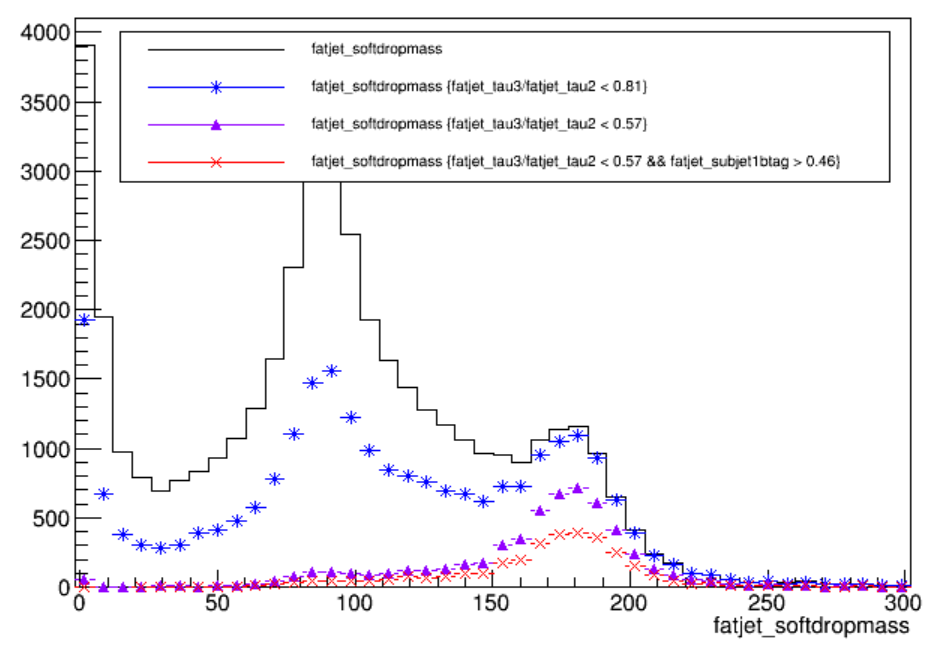
Groomed mass, jet substructure, and subjet b-tagging were the backbone of early boosted jet identification in CMS. The figure below shows an example of isolating top quark jets by applying various mass and substructure criteria. However, these algorithms have now been eclipsed by deep neural network identification techniques.
| Object property | Type | Description |
|---|---|---|
| FatJet_msoftdrop | Float_t | Corrected soft drop mass with PUPPI |
| FatJet_n2b1 | Float_t | N2 with beta=1 |
| FatJet_n3b1 | Float_t | N3 with beta=1 |
| FatJet_subJetIdx1 | Int_t | (index to Subjet) index of first subjet |
| FatJet_subJetIdx2 | Int_t | (index to Subjet) index of second subjet |
| FatJet_tau1 | Float_t | Nsubjettiness (1 axis) |
| FatJet_tau2 | Float_t | Nsubjettiness (2 axis) |
| FatJet_tau3 | Float_t | Nsubjettiness (3 axis) |
| FatJet_tau4 | Float_t | Nsubjettiness (4 axis) |
Deep Neural Network taggers
During Run 2, CMS analysts developed many neural network identification schemes for large-radius jets. The best performers have been preserved in the version of NanoAOD available for Open Data. The main algorithms are:
- DeepDoubleX (or “double-b”): a Boosted Decision Tree optimized for decays of massive particles to a pair of b or c quarks.
- DeepBoostedJet (or “DeepAK8”): a Convolutional Neural Network combined with a dense network that uses particle-flow candidates and secondary vertices to determine the parent particle of the jet
- ParticleNet: a Dynamic Graph Convolutional Neural Network applied on “point cloud” data structures built from the particle-flow candidates within a jet.
The deep network taggers provide discriminants for many different particle hypotheses. These are typically grouped into “binarized” discriminants intended to separate a particular massive particle (top, Higgs, etc) from light quark jets. Both DeepAK8 and ParticleNet offer “mass-decorrelated” discriminants, for which the network has been trained in such a way that jet mass is not part of the learning process. For analyses that use the jet mass distribution as a key sensitive variable, decorrelation helps maintain a smoothly falling light-quark jet mass distribution, with no artificial peak near the region of interest (eg, near 125 GeV for Higgs bosons, or new 170 GeV for top quarks).
The branches available in NanoAOD for the deep network taggers are listed below.
| Object property | Type | Description |
|---|---|---|
| FatJet_btagDDBvLV2 | Float_t | DeepDoubleX V2(mass-decorrelated) discriminator for H(Z)->bb vs QCD |
| FatJet_btagDDCvBV2 | Float_t | DeepDoubleX V2 (mass-decorrelated) discriminator for H(Z)->cc vs H(Z)->bb |
| FatJet_btagDDCvLV2 | Float_t | DeepDoubleX V2 (mass-decorrelated) discriminator for H(Z)->cc vs QCD |
| FatJet_btagHbb | Float_t | Higgs to BB tagger discriminator |
| FatJet_deepTagMD_H4qvsQCD | Float_t | Mass-decorrelated DeepBoostedJet tagger H->4q vs QCD discriminator |
| FatJet_deepTagMD_HbbvsQCD | Float_t | Mass-decorrelated DeepBoostedJet tagger H->bb vs QCD discriminator |
| FatJet_deepTagMD_TvsQCD | Float_t | Mass-decorrelated DeepBoostedJet tagger top vs QCD discriminator |
| FatJet_deepTagMD_WvsQCD | Float_t | Mass-decorrelated DeepBoostedJet tagger W vs QCD discriminator |
| FatJet_deepTagMD_ZHbbvsQCD | Float_t | Mass-decorrelated DeepBoostedJet tagger Z/H->bb vs QCD discriminator |
| FatJet_deepTagMD_ZHccvsQCD | Float_t | Mass-decorrelated DeepBoostedJet tagger Z/H->cc vs QCD discriminator |
| FatJet_deepTagMD_ZbbvsQCD | Float_t | Mass-decorrelated DeepBoostedJet tagger Z->bb vs QCD discriminator |
| FatJet_deepTagMD_ZvsQCD | Float_t | Mass-decorrelated DeepBoostedJet tagger Z vs QCD discriminator |
| FatJet_deepTagMD_bbvsLight | Float_t | Mass-decorrelated DeepBoostedJet tagger Z/H/gluon->bb vs light flavour discriminator |
| FatJet_deepTagMD_ccvsLight | Float_t | Mass-decorrelated DeepBoostedJet tagger Z/H/gluon->cc vs light flavour discriminator |
| FatJet_deepTag_H | Float_t | DeepBoostedJet tagger H(bb,cc,4q) sum |
| FatJet_deepTag_QCD | Float_t | DeepBoostedJet tagger QCD(bb,cc,b,c,others) sum |
| FatJet_deepTag_QCDothers | Float_t | DeepBoostedJet tagger QCDothers value |
| FatJet_deepTag_TvsQCD | Float_t | DeepBoostedJet tagger top vs QCD discriminator |
| FatJet_deepTag_WvsQCD | Float_t | DeepBoostedJet tagger W vs QCD discriminator |
| FatJet_deepTag_ZvsQCD | Float_t | DeepBoostedJet tagger Z vs QCD discriminator |
| FatJet_particleNetMD_QCD | Float_t | Mass-decorrelated ParticleNet tagger raw QCD score |
| FatJet_particleNetMD_Xbb | Float_t | Mass-decorrelated ParticleNet tagger raw X->bb score. For X->bb vs QCD tagging, use Xbb/(Xbb+QCD) |
| FatJet_particleNetMD_Xcc | Float_t | Mass-decorrelated ParticleNet tagger raw X->cc score. For X->cc vs QCD tagging, use Xcc/(Xcc+QCD) |
| FatJet_particleNetMD_Xqq | Float_t | Mass-decorrelated ParticleNet tagger raw X->qq (uds) score. For X->qq vs QCD tagging, use Xqq/(Xqq+QCD). For W vs QCD tagging, use (Xcc+Xqq)/(Xcc+Xqq+QCD) |
| FatJet_particleNet_H4qvsQCD | Float_t | ParticleNet tagger H(->VV->qqqq) vs QCD discriminator |
| FatJet_particleNet_HbbvsQCD | Float_t | ParticleNet tagger H(->bb) vs QCD discriminator |
| FatJet_particleNet_HccvsQCD | Float_t | ParticleNet tagger H(->cc) vs QCD discriminator |
| FatJet_particleNet_QCD | Float_t | ParticleNet tagger QCD(bb,cc,b,c,others) sum |
| FatJet_particleNet_TvsQCD | Float_t | ParticleNet tagger top vs QCD discriminator |
| FatJet_particleNet_WvsQCD | Float_t | ParticleNet tagger W vs QCD discriminator |
| FatJet_particleNet_ZvsQCD | Float_t | ParticleNet tagger Z vs QCD discriminator |
| FatJet_particleNet_mass | Float_t | ParticleNet mass regression |
- Tagging algorithms separate heavy flavor jets from jets produced by the hadronization of light quarks and gluons
- FatJet tagging algorithms can identify jets from massive SM particles
- Tagging algorithms produce a disriminator value for each jet that represents the likelihood that the jet came from a particular particle
- Each tagging algorithm has recommended ‘working points’ (discriminator values) based on a misidentification probability for non-interesting jets