
Analysis workflow
Last updated on 2026-07-13 | Edit this page
Estimated time: 125 minutes
Overview
Questions
- What does a full analysis “look” like?
- What is involved for analysts for a more complicated search?
- What does an experimentalist need to keep track of?
- How do all the different parts of an analysis fit together?
Objectives
- Conceptually understand all the different parts that go into an analysis.
Background
Dozens or even hundreds of particle physics analyses are performed every year. It’s challenging and not every analysis is the same, but there is a basic workflow that can be helpful to understand.
In this lesson, we provide material for a self-guided walkthrough of the individual steps and overarching workflow of a particle physics analysis.
The material is presented at a conceptual level, without going into the details or describing the specific analysis tools. These materials were presented at other workshops which might be different than this one, so you may see or hear some jargon which goes unexplained. Feel free to keep notes and ask your facilitators about these terms during this workshop.
CMS DAS (CMS Data Analysis School) - “Analysis Overview”
Every year, the CMS experiment organizes a number of Data Analysis Schools that we refer to as CMSDAS. These serve as an introduction to new undergraduate students, graduate students, and post-docs as well as a refresher for any collaborator who wants to know the latest computational tools and techniques.
In 2021, Matt Bellis (Siena University) provided an analysis overview at a very high level, designed to map out different components of an analysis. The video and the slides are provided below.
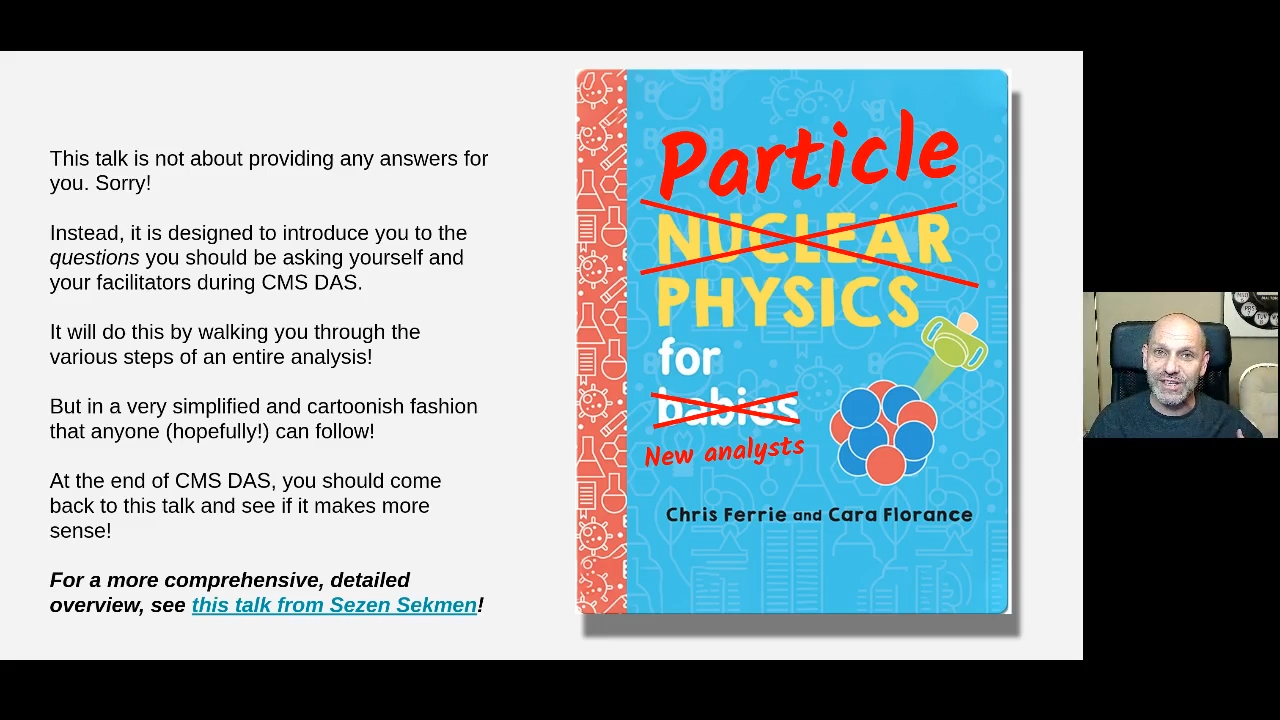
More on the analysis workflow
In 2024, at the Workshop on High Energy Physics Phenomenology (WHEPP), the CMS DPOA group ran a remote workshop on how to access and use our open data. Participants eventually worked to reconstruct the top quark and measure its properties.
At the start of that exercise, we gave a conceptual overview of the steps involved in a general analysis and the tools the participants we would use. We do not have a recording of the presentations, but the slides have enough text that a reader should be able to follow the main points.
- There are many steps to a particle physics analysis
- These steps are similar for many studies and there are software tools which make those steps easier