
Finding the Truth Labels
Last updated on 2026-07-24 | Edit this page
Overview
Questions
- Why does training a model require already knowing the right answer for each example?
- How do we identify which simulated particles came from the Higgs boson, using only ID numbers?
- How do we match a truth-level quark to an actual reconstructed jet, and why is that not automatic?
- Why does the QCD background sample not need any of this matching?
- How does all of this become the label (0, 1, or 2) attached to each training example?
Objectives
- Explain what supervised learning means and why simulated data provides a built-in answer key.
- Identify a particle’s type and parent using
GenPart_pdgIdandGenPart_genPartIdxMother. - Compute the angular distance ΔR between two directions and explain
why
phineeds special handling. - Explain why matching jets to truth quarks is unnecessary for the QCD background sample.
- Describe how surviving events are turned into labeled training examples.
Run this first
PYTHON
def delta_phi(phi1, phi2):
    dphi = phi1 - phi2
    return (dphi + np.pi) % (2*np.pi) - np.pi

def extract_features(filepath, label, is_signal=True, max_events=None):
    tree = uproot.open(filepath)["Events"]

    # Load required branches
    branches = FEATURE_NAMES.copy()
    if is_signal:
        branches += [
            "GenPart_pdgId", "GenPart_pt", "GenPart_eta",
            "GenPart_phi", "GenPart_mass", "GenPart_genPartIdxMother"
        ]

    events = tree.arrays(branches, entry_stop=max_events)

    if is_signal:
        # Determine target quark based on label (0: b-quark=5, 1: c-quark=4)
        target_pdg = 5 if label == 0 else 4

        mother_idx = events.GenPart_genPartIdxMother
        valid = mother_idx >= 0
        mother_pdg = ak.where(valid, events.GenPart_pdgId[mother_idx], -999)

        is_higgs_dau = (abs(events.GenPart_pdgId) == target_pdg) & (mother_pdg == 25)
        mask = ak.num(events.GenPart_pt[is_higgs_dau]) == 2
        events = events[mask]
        is_higgs_dau = is_higgs_dau[mask]

        # Build 4-vectors
        jets = ak.zip({
            "pt": events.Jet_pt, "eta": events.Jet_eta,
            "phi": events.Jet_phi, "mass": events.Jet_mass
        }, with_name="Momentum4D")

        dau = ak.zip({
            "pt": events.GenPart_pt[is_higgs_dau], "eta": events.GenPart_eta[is_higgs_dau],
            "phi": events.GenPart_phi[is_higgs_dau], "mass": events.GenPart_mass[is_higgs_dau]
        }, with_name="Momentum4D")

        d1, d2 = dau[:, 0], dau[:, 1]

        # Match using dR < 0.4
        dr1 = np.sqrt((jets.eta - d1.eta[:, None])**2 + delta_phi(jets.phi, d1.phi[:, None])**2)
        dr2 = np.sqrt((jets.eta - d2.eta[:, None])**2 + delta_phi(jets.phi, d2.phi[:, None])**2)
        matched = (dr1 < 0.4) | (dr2 < 0.4)

        # Extract features for matched jets
        matched_events = events[matched]

        # Keep exactly 2 matched jets
        mask_2jets = ak.num(matched_events.Jet_pt) == 2
        final_events = matched_events[mask_2jets]

    else:
        # For QCD, require at least 2 jets and take the top 2 leading jets
        mask_2jets = ak.num(events.Jet_pt) >= 2
        events = events[mask_2jets]
        # Slice to keep only the first 2 jets
        final_events = events[:, :2]

    # Stack features into a NumPy array of shape (N_events, 2_jets, N_features)
    feature_list = []
    for feat in FEATURE_NAMES:
        # Fill missing values with 0 (e.g., puId might have NaNs depending on pt)
        arr = ak.fill_none(final_events[feat], 0)
        feature_list.append(ak.to_numpy(arr))

    X = np.stack(feature_list, axis=-1)
    y = np.full(X.shape[0], label)

    print(f"Loaded label {label}: {X.shape[0]} events")
    return X, y
Run the block above first, then read on to see what each part does.
This defines extract_features(), which this episode
builds piece by piece below - a single function that takes a file path,
a label, and whether the sample is signal or background, and returns the
finished (X, y) arrays. It isn’t called yet - that happens
once per file in Preparing the
Data.
Why we need an answer key
To train a model with examples, we need to already know the right answer for each one - otherwise there’s nothing to learn from. This is called supervised learning: a known answer supervises (corrects) the model while it learns.
For real collision data, nobody can look at the debris and just
know which quark caused which jet. But for
simulated data, the simulation generated the whole
event starting from “create a Higgs boson that decays to two bottom
quarks,” so it also secretly records what actually happened at the truth
level, before detector effects blur things. That record is stored in
extra columns starting with GenPart_* (“Generator-level
Particle”). We only use these truth columns to build our training
labels - the model itself never sees them.
The two signal files (ttHTobb, ttHTocc): matching jets to truth
In plain words, before any code: jets are matched to generator-level truth quarks by angular distance (ΔR), and only jets that survive that match get used to build a training label - anything that doesn’t match close enough to a truth quark is thrown away.
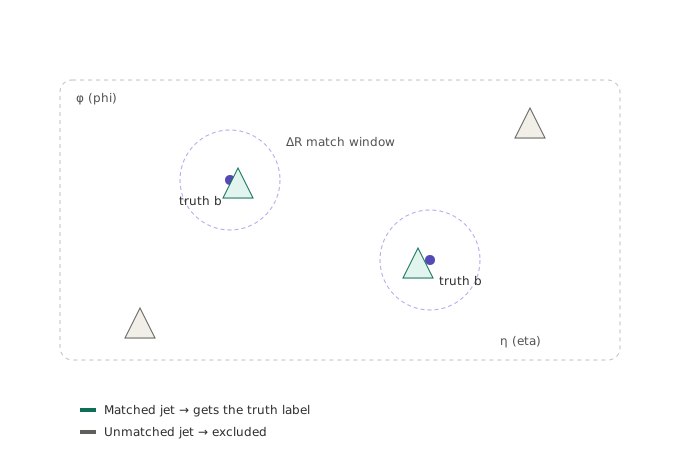
For the signal samples, we need to figure out: of all the jets in
this event, which ones actually came from the Higgs boson’s b-quarks (or
c-quarks)? This is a two-step process, handled inside the
extract_features() function you already ran above.
Step 1 - Find the Higgs boson’s daughter quarks
Every particle in GenPart_* has: -
GenPart_pdgId - an ID number identifying what the
particle is, using the standard PDG ID scheme:
5 = bottom quark, 4 = charm quark
(-5/-4 are their antimatter partners, hence
abs(pdgId)), 25 = Higgs boson. -
GenPart_genPartIdxMother - which earlier particle in the
list is this particle’s “parent.”
So “find the Higgs boson’s daughter quarks” becomes: find particles whose ID is ±5 (or ±4) and whose parent’s ID is 25.
PYTHON
target_pdg = 5 if label == 0 else 4          # 5 = bottom quark, 4 = charm quark
mother_pdg = ak.where(valid, events.GenPart_pdgId[mother_idx], -999)
is_higgs_dau = (abs(events.GenPart_pdgId) == target_pdg) & (mother_pdg == 25)
A Higgs decaying to two quarks should have exactly two of these, so we throw away any event where that isn’t true:
ak.num(...) counts how many entries survive the filter
per event (since every event can have a different number of
GenPart_* entries); mask then keeps only
events with exactly two daughter quarks.
Step 2 - Match those quarks to actual reconstructed jets
Knowing which truth-level quarks came from the Higgs isn’t quite enough - we need to know which reconstructed jets correspond to them. We do that with a geometric trick.
eta and phi are like latitude and longitude
for a particle’s direction. We measure the “distance” between a jet and
a truth quark using ΔR (“delta R”):
ΔR = sqrt( (Δeta)² + (Δphi)² )A small ΔR means the jet and quark point in almost the same direction - good evidence the jet is the spray created by that quark. We use a threshold of ΔR < 0.4, matching the cone size CMS’s jet-clustering algorithm actually used to build the jet in the first place:
PYTHON
dr1 = np.sqrt((jets.eta - d1.eta[:, None])**2 + delta_phi(jets.phi, d1.phi[:, None])**2)
matched = (dr1 < 0.4) | (dr2 < 0.4)
matched is True for any jet within ΔR of
0.4 of either Higgs daughter quark - this is what turns “here is a
truth-level quark” into “here is the jet it produced.”
Why delta_phi needs its own function
phi wraps around a circle (0 to 2π, then back to 0),
like a clock face. If one jet is at phi = 0.1 and another
at phi = 6.2 (near 2π), a naive subtraction says they’re
almost 3.5 radians apart, when really they’re neighbors either side of
the wraparound point. delta_phi fixes that by squeezing the
difference back into [-π, π], so it always reports the
shortest way around the circle:
The background file (QCD): no matching needed
For the QCD background sample, there’s no Higgs boson to match to. So we take the simpler approach of grabbing the two highest-momentum (“leading”) jets in each event:
Turning this into labels
Every surviving event becomes one training example: 2 jets × 10 features, with one label attached:
-
label = 0→ the jet pair is from Hbb -
label = 1→ the jet pair is from Hcc -
label = 2→ the jet pair is QCD background
Quick recap
- Truth-level (
GenPart_*) columns exist only in simulation, and only get used to build labels - never fed to the model. - We find the Higgs boson’s daughter quarks by PDG ID (5 = bottom, 4 = charm) and mother ID (25 = Higgs).
- We match those truth quarks to real jets using ΔR - a “distance on
the sky” built from
etaandphi. - QCD background just uses the two leading jets, since there’s no Higgs decay to match to.
- Next: Preparing the Data - preparing this data to actually feed into a neural network.
Question
Q: Suppose you changed the matching threshold from
dr1 < 0.4 to a much stricter dr1 < 0.1
(and the same for dr2). Would you expect
final_events to end up with more, fewer, or about the same
number of events, and why?
A: Fewer events. A stricter (smaller) ΔR threshold means a jet has to point much closer to a truth quark’s direction to count as “matched.” Some jets that would have matched at ΔR < 0.4 will now fail the ΔR < 0.1 cut, so fewer events will end up with exactly two matched jets. This is a real tradeoff: a tighter threshold gives more confidence a match is correct, at the cost of throwing away usable events.
- Truth-level (
GenPart_*) columns exist only in simulation, and only get used to build labels, never fed to the model. - We find the Higgs boson’s daughter quarks by PDG ID (5 = bottom, 4 = charm) and mother ID (25 = Higgs).
- We match those truth quarks to real jets using ΔR, a “distance on
the sky” built from
etaandphi, using a 0.4 threshold that matches the jet clustering cone size. - QCD background just uses the two leading jets, since there’s no Higgs decay to match to.